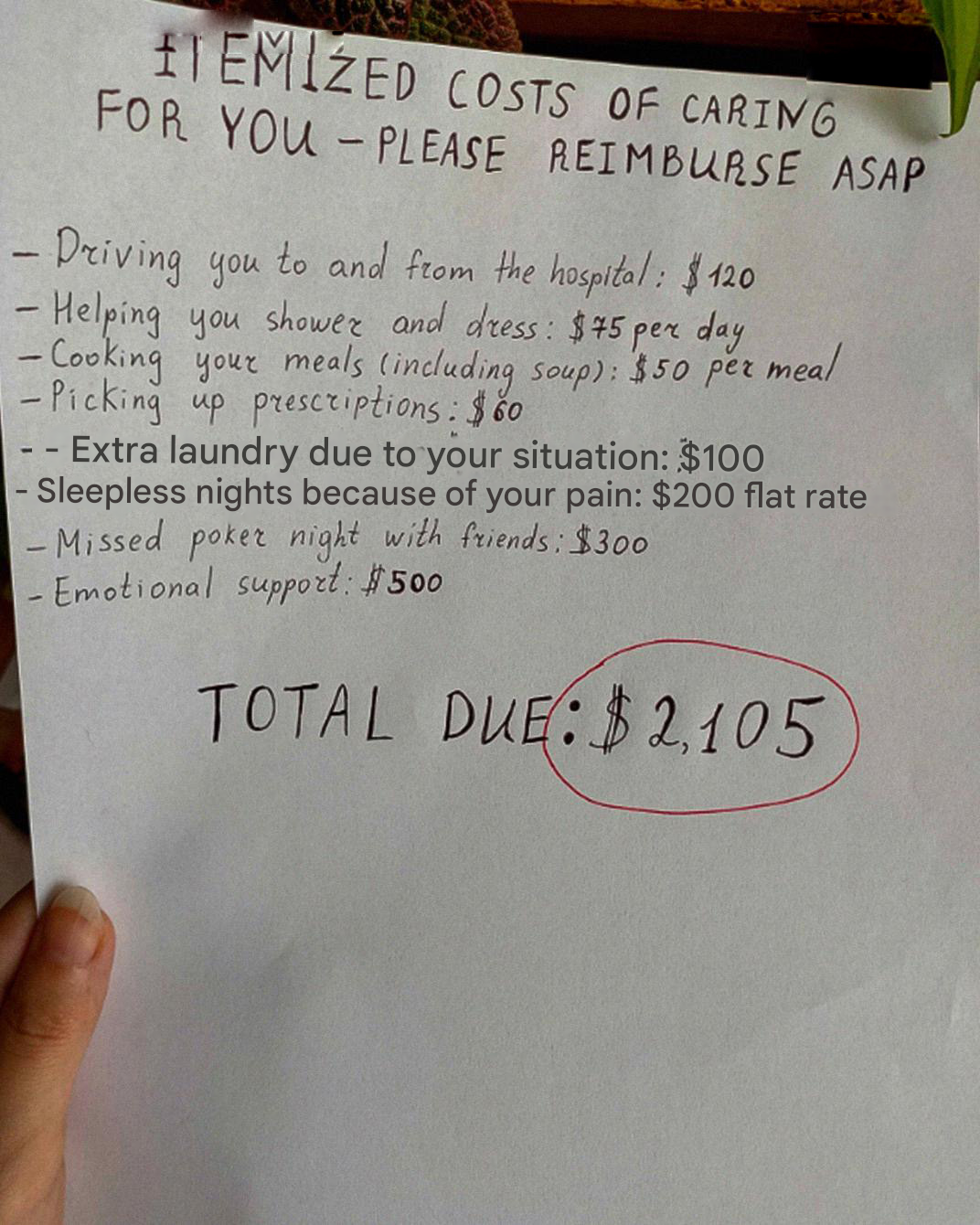
This wasn’t a sick joke or some twisted attempt at humor. This was his serious, methodical accounting of every moment he’d spent taking care of his recovering wife.
I whispered into the empty kitchen, “What kind of man does this?”
Suddenly, the house started feeling different. It felt like I was standing in a place that was no longer my home.
Continued on next page:
At that point, my phone buzzed. It was a text from my best friend, Emily.
“How are you feeling today? Need anything?”
I stared at the message, then back at the invoice. Emily had driven 40 minutes to bring me homemade chicken soup two days ago. She’d stayed for three hours, helping me organize my medications and just talking to keep my spirits up. But she hadn’t sent me a bill.
That’s when something inside me hardened and crystallized into pure determination.
If Daniel wanted to treat my recovery like a business transaction, I’d give him exactly what he asked for. But my version of accounting would hurt a lot more than his wallet.
I carefully removed the invoice from the fridge and took a picture of it as evidence. Then, I hobbled to my laptop and opened a new spreadsheet.
If he wanted to play this game, I was about to show him how it was really done.
For the next three weeks, I kept meticulous records of everything.
Every dinner I cooked, despite still being in recovery, cost $80, which included a service fee plus ingredients. Every shirt I ironed for his work wardrobe cost $15 each. Every errand I ran while still healing from major surgery was $45, plus mileage. Grocery shopping while managing post-surgical fatigue? $120, including a “pain and suffering” surcharge.
I documented conversations, too.
Listening to him complain about his difficult clients over dinner – $75 per session for “therapeutic listening services.”
Providing reassurance about his mother’s passive-aggressive comments about our childless marriage – $150 flat rate for “emotional labor.”
I even included a retroactive billing section.
Ver continuación en la página siguiente
