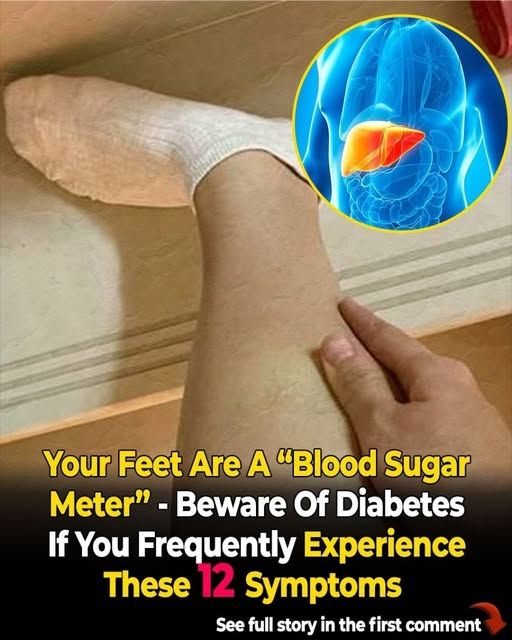
No fever. No fatigue.
But something’s off in your feet.
Maybe they tingle. Or feel unusually dry. Or you’ve noticed sores that aren’t healing.
Here’s what many people don’t realize: 👉 The feet are often the first place where long-term high blood sugar reveals itself.
Because nerves and small blood vessels in the feet are delicate and widespread, they’re especially vulnerable to damage from uncontrolled glucose levels.
And while your feet aren’t a “blood sugar meter,” they can send quiet signals — whispers — that something deeper might be going on.
Let’s explore 12 common foot-related symptoms linked to elevated blood sugar — so you can respond not with panic, but with awareness.
Because real health isn’t about waiting for a diagnosis. It’s about listening when your body speaks softly
🔍 Why Feet Are So Sensitive to Blood Sugar Changes
Over time, consistently high blood glucose can:
Damage nerves → leading to diabetic neuropathy
Harm blood vessels → reducing circulation to extremities
Weaken immune response → slowing wound healing
These changes develop slowly — often over years — which is why many people don’t notice symptoms until complications arise.
🩺 The good news? Early detection means better outcomes. And paying attention to your feet can help catch issues before they become serious.
⚠️ 12 Foot Symptoms Linked to High Blood Sugar
1. Tingling or “Pins and Needles”
Feels like electric shocks or buzzing
Often worse at night
One of the earliest signs of nerve damage
📌 Commonly starts in toes and moves upward.
2. Numbness
To see the full instructions for this recipe, go to the next page or click the open button (>) and don’t forget to share it with your friends on Facebook.
Reduced ability to feel touch, heat, or cold
Increases risk of injury without knowing
⚠️ Can lead to unnoticed cuts, blisters, or burns.
3. Burning Sensation
Deep, persistent burning pain in soles or heels
Often described as “walking on hot coals”
🔥 Medically known as positive neuropathic symptoms — a sign of irritated nerves.
4. Sharp or Shooting Pain
Sudden, stabbing pain in feet or legs
May occur at rest or during movement
💡 Not typical arthritis — consider blood sugar evaluation.
5. Loss of Balance or Coordination
Feeling unsteady on your feet
Tripping more often
🧠 Caused by loss of sensation (proprioception) due to nerve damage.
6. Dry, Cracked Skin
Especially around heels
Due to nerve damage affecting sweat glands
💧 Without moisture, skin cracks — creating entry points for infection.
7. Changes in Foot Shape
Hammertoes
Collapsing arches (flat feet)
Charcot foot (rare but serious — bones weaken and shift)
May get infected easily
🩸 Poor circulation + weakened immunity = delayed recovery.
9. Cold Feet (Even in Warm Weather)
Reduced blood flow makes feet feel icy
Can happen even with warm socks
🌡️ A sign of peripheral artery disease (PAD), which is more common in people with diabetes.
10. Discoloration
Red, blue, or purple tint to toes or feet
Indicates poor oxygen delivery
🫀 Could signal circulation problems or inflammation.
11. Thickened or Discolored Toenails
Yellowing, brittleness, or fungal infections
Often mistaken for simple nail fungus — but may reflect underlying glucose imbalance
🔍 Fungal growth thrives in high-sugar environments.
12. Hair Loss on Feet or Legs
Thinning or missing hair on lower legs/toes
Due to reduced circulation
📉 Like plants without water — tissues struggle to thrive.
✅ Who Should Be Screened?
To see the full instructions for this recipe, go to the next page or click the open button (>) and don’t forget to share it with your friends on Facebook.
You’re at higher risk if you:
Are overweight or obese
Have a family history of type 2 diabetes
Had gestational diabetes
Are physically inactive
Have high blood pressure or cholesterol
🩺 Talk to your doctor about getting tested for prediabetes or diabetes — simple blood tests can detect it early.
Test
What It Measures
✅ HbA1c
Average blood sugar over 2–3 months
✅ Fasting Blood Glucose
Blood sugar after 8+ hours without food
✅ Oral Glucose Tolerance Test
How your body handles sugar
🎯 Goal: Catch prediabetes before it becomes full-blown diabetes.
✅ Daily Foot Care Tips (For Everyone — Especially at Risk)
Habit
Benefit
✅ Inspect feet daily
Use a mirror to check bottoms — look for cuts, redness, swelling
✅ Wash & dry thoroughly
Especially between toes
✅ Moisturize (but not between toes)
Prevents cracking
✅ Wear well-fitting shoes
Avoid blisters and pressure points
✅ Never walk barefoot
Protect against injuries
✅ See a podiatrist annually
Even if no symptoms
🩺 For people with diabetes: This is non-negotiable.
❌ Debunking the Myths
Myth
Truth
❌ “Only diabetics get foot neuropathy”
False — other conditions (vitamin deficiencies, alcoholism) can cause it too
❌ “If I don’t have pain, I’m safe”
Dangerous myth — numbness hides damage
❌ “I’d know if my blood sugar was high”
Not true — prediabetes has no obvious symptoms
❌ “Natural remedies can reverse neuropathy”
No cure exists — only management through glucose control
Final Thoughts
You don’t need pain to know something’s wrong.
But you do deserve to notice the quiet warnings — the dry heel, the tingling toe, the sock that feels tighter than before.
So next time you’re taking off your shoes… pause.
Look down. Ask gently:
Have my feet changed?
Then act — calmly, bravely, and without delay.
Because real prevention doesn’t start in the ER. It starts in the moment you decide to pay attention.
And that kind of awareness? It could save your steps — and your life.
To see the full instructions for this recipe, go to the next page or click the open button (>) and don’t forget to share it with your friends on Facebook.
